We launched AskMandla a year ago today. Choosing Workers' Day as our start date felt right at the time, and looking back, it was an even better choice than we realised.
Our first goal was to build a compliance tool. We focused on HR workflows, employment contracts, and payroll processing, the basic systems that domestic workers and their employers have needed but often lacked. The plan was to create this infrastructure, formalise employment relationships, and help everyone follow the law.
That approach wasn’t wrong, but it wasn’t the complete picture.
Again and again, workers told us something simple and urgent: they needed access to money they had already earned. Not a loan or credit, but their own wages, available mid-month before payday. This was for essentials like groceries or school shoes. Without a credit card or help from family, a cash shortfall could mean turning to a loan shark.
That feedback shifted the direction of our company.
We launched Earned Wage Access (EWA) on 9 April. Since then, we’ve averaged about one transaction a day. Workers chat with Mandla on WhatsApp, request an advance on their earned wages, and receive the money in their account within 24 hours. Our fees are clear, set upfront before any transaction, and matched to our customers’ income levels. There are no hidden charges or surprises.
That was our product pivot. But to understand how we got here, it helps to look back further than just the past year.
AskMandla started as an evolution of Shesha-LawZA, a platform created by Janine Kane-Berman, our CLO, who knows domestic labour law in South Africa better than almost anyone I know. Shesha gave domestic workers and employers access to contracts, compliance guidance, and HR tools through an app. The idea worked, but the delivery method was a challenge. Apps are costly to build, hard to maintain, and require people to download and return to them. Domestic workers aren’t at desks; they use WhatsApp.
So we rebuilt the platform to work on WhatsApp first, making it conversational and removing the need for an app. Now, if a worker has a dispute with their employer at 8pm on a Thursday, they can chat with Mandla and get BCEA-compliant guidance right away. There’s no call centre, no waiting, and no cost to access the guidance.
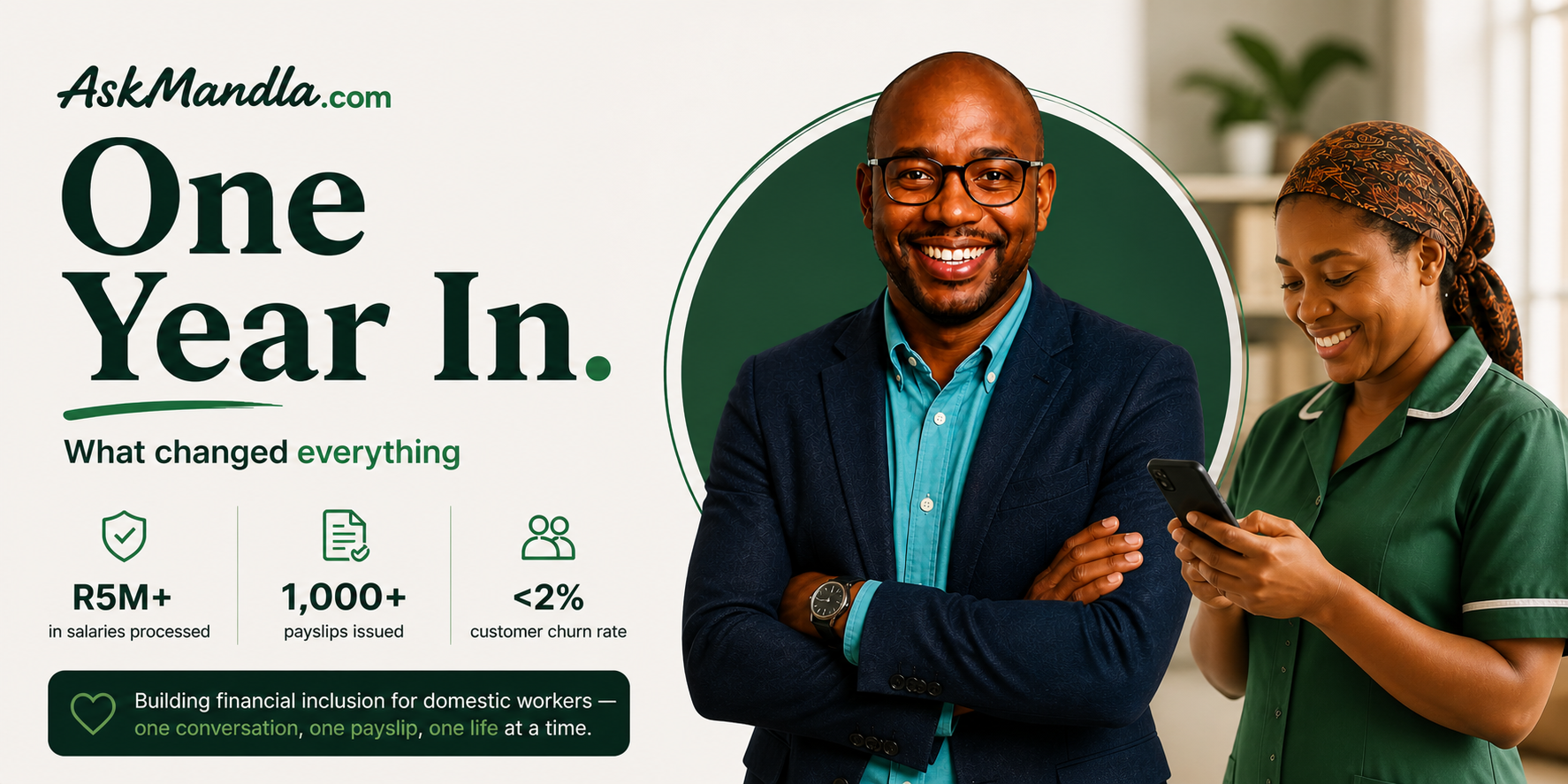
Our first year’s numbers tell part of our story. We’ve processed over R5 million in salaries for domestic workers and issued nearly 1,000 payslips. Our churn rate is under 2%. That last figure is important to us; it shows people stay because the product works, not because it’s hard to leave.
The payslips are what I’m most proud of. A payslip is more than just a piece of paper. For a domestic worker who has spent years without a contract, UIF registration, or documented income, a monthly payslip is proof of employment. It’s what you show a bank when applying for credit or an insurer. It’s the first step toward financial inclusion in a country where millions have been excluded from formal financial systems simply because their jobs were never officially recorded.
That’s what formalising these relationships really means. We’re not just helping employers avoid fines for non-compliance; we’re giving workers a documented economic identity. This opens the door to real financial products. EWA is just the start; savings products, insurance, and healthcare access are on the way. We’re already hearing from workers who want to save R500 or R600 a month for year-end. That’s a big step. That’s financial agency.
We are a for-profit business, and I want to be clear about that. Sometimes, the impact story lets companies avoid building sustainable economics. We charge for our services. The compliance and payroll platform uses a subscription fee, and EWA has a clear fee structure. Future financial products will also be priced fairly. We will not hide costs, lock people into confusing products, or charge unfair fees. That’s our standard.
Our team deserves recognition for getting us here. Janine built the legal and operational foundation. Stephan created the technology. Ean is building our growth engine. Given supports our customers every day. Tech Pete, Keren, and everyone who invested their time and money made this possible. Our shareholders believed in us before we had results. This company is a team effort.
I also want to share why I’m personally committed to this work. I love South Africa. I want to live here and for my children to grow up here. That means facing tough challenges, such as unemployment, inequality, and the gap between formal and informal economic participation, which leaves millions without basic financial infrastructure.
AskMandla is one solution to part of that problem. It’s not the whole answer, but it’s a real one built for the people who need it, on the platform they already use, with products designed for their lives.
After one year, we’ve processed R5 million in salaries, launched EWA, and we’re just getting started.
To every domestic worker who trusted us with their payroll this year, this is for you.